



Australia’s Inland Rail: What the Progress and Problems Really Mean for Supply Chain Operators
Australia’s Inland Rail project is often described as transformational, ambitious, and once-in-a-generation infrastructure. All of that may be true, but for supply chain operators, the real question is much more practical: how soon will it make freight movements easier, cheaper, and more predictable?
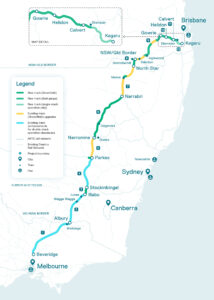
The 1,600-km Melbourne-to-Brisbane rail corridor has been under construction for years, and recent months have delivered measurable progress. Sections of track are nearing completion, new bridge works are rolling out, and early-stage works for critical intermodal hubs are underway. But alongside the construction news comes a steady drumbeat of cost blowouts, revised timelines, and engineering challenges that complicate the picture for freight planners.
For logistics businesses, Inland Rail is no longer just an engineering project. It is a strategic variable that could reshape linehaul operations, fleet investments, customer commitments, and export planning for decades. And right now, many operators are unsure how to incorporate it into their long-term thinking.
The Progress: A Freight Network With Serious Potential
Where the project is moving forward, it is doing so with purpose. Once operational, the Inland Rail is expected to deliver several advantages that directly matter to logistics operators:
- faster north-south transit times
- more reliable scheduling compared to congested East Coast trucking routes
- double-stack capability for more efficient train loading
- smoother alignments that support longer, heavier, and more predictable services
- improved connections for agricultural regions that currently rely heavily on roads
For exporters, particularly grain, cotton, meat, minerals, and manufactured goods, this could significantly reduce the volatility and bottlenecks that have plagued supply chains during peak seasons or major weather events.
The promise is clear: a stronger backbone for national freight. A rail system that finally matches the scale of Australian distances. A network that gives operators options instead of forcing them to rely on road capacity and driver availability.
The Problem: Supply Chain Planning Needs Certainty, and Inland Rail Isn’t There Yet
But it’s impossible to ignore the challenges. The project’s cost overruns are well publicised, and each new review seems to add more complexity to the delivery timeline. For supply chain leaders who build strategies around multi-year investment horizons, shifting dates creates real operational risk.
If the corridor is not complete, or only partially complete, logistics providers face a blend of old constraints and new uncertainties:
- difficult handover points between completed and incomplete sections
- unclear freight pricing models
- unpredictable timing for intermodal terminal readiness
- challenges aligning customer expectations with infrastructure staging
- uncertainty around whether rail will truly offer savings over road
Supply chain directors repeatedly highlight the same issue: they cannot redesign national networks around a project that doesn’t yet have a stable, credible completion schedule.
Community, Environmental, and Engineering Complexity
Another factor shaping the outcome is the need for engineers to address major environmental and community concerns. Floodplain modelling in particular has required design revisions that add time and cost. In some regions, residents are demanding more clarity on land impacts, noise, safety, and water flow.
While these factors may feel distant from day-to-day logistics operations, they directly influence when the network becomes usable. In a supply chain environment where weather disruptions are increasingly common, the industry needs confidence that the corridor will stand up to extreme conditions rather than contribute to them.
Operators are also watching how well the ARTC and government stakeholders handle transparency. Many recall past infrastructure projects where business expectations were misaligned with final operational reality. Inland Rail cannot afford that disconnect.
What It Means for Freight Operators Today
Despite the uncertainty, the industry is not standing still. Supply chain leaders are taking a pragmatic approach:
- planning flexible linehaul models that can switch between road and rail
- investing in intermodal capability to be ready when new hubs open
- modelling long-term freight flows assuming partial Inland Rail access
- assessing warehouse locations based on future rail proximity
- preparing for new service patterns that could lower carbon footprints
At the same time, operators are cautious. Few are committing to large-scale network redesigns until Inland Rail’s timeline becomes firmer.
For many, the opportunity is clear but distant. Inland Rail could ease trucking capacity pressures, reduce transit-time volatility, support export surges, and make domestic distribution more predictable. But the path to those outcomes is still developing.
The Long-Term View: Still Worth the Investment
Despite the frustrations and delays, most logistics professionals agree on one point: Australia needs Inland Rail. Without it, freight pressure on East Coast highways will continue to rise, driver shortages will worsen, and exporters will remain vulnerable to bottlenecks they cannot control.
Even if the full network is years away, the eventual benefits remain compelling:
- more balanced national freight flows
- reduced dependence on long-haul trucking
- stronger resilience during floods, fires, and extreme weather
- better connections for regional producers
- long-term operating cost savings compared to the road
Inland Rail is not a simple project, but few infrastructure programs with such a national impact ever are.
The Bottom Line
Inland Rail is progressing, but unevenly. It offers enormous potential, but not yet enough certainty in the project timeline for logistics businesses to fully commit. It could reshape Australian freight for the better, but only if governance, engineering, and delivery challenges are managed with transparency and discipline.
For now, supply chain operators are doing what they do best: preparing for multiple scenarios, staying agile, and watching closely as the country’s most ambitious freight project continues to unfold.